

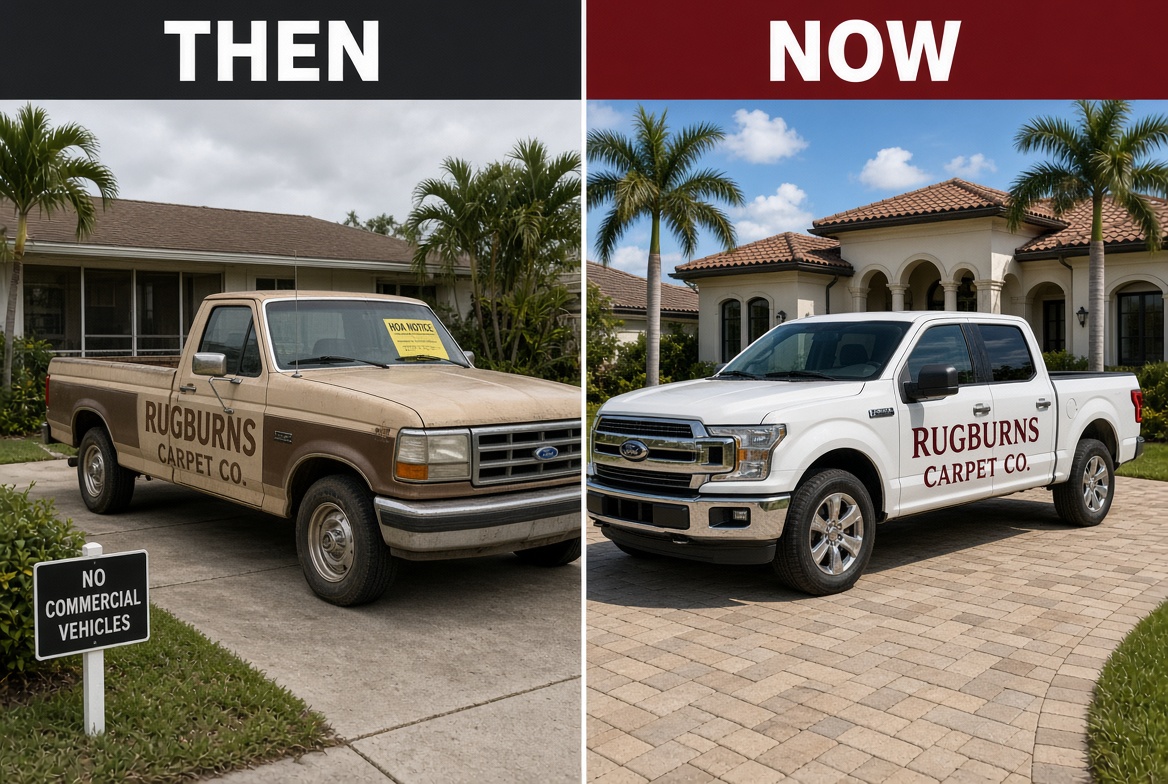
For decades, HOA rules treated a pickup with a company name on the door like a dump truck. Florida’s 2024 law finally separated those two things. Here’s what the new rule covers, what it leaves alone, and why condo owners are in a different boat.
If you live in a Southwest Florida HOA and drive a pickup, a contractor truck, or a work van, you have probably seen a rule that says “no commercial vehicles” or “no trucks in the driveway overnight.”
Those rules were not written for today’s F-150. They were written for a different vehicle, and a different idea of what belongs on a residential street.
How we got the “no trucks” rule
Most of these limits come from the 1960s through 1980s, when planned neighborhoods were spreading across Florida. Builders packed curb-appeal rules into one paragraph: no boats, no RVs, no trailers, no trucks, no commercial vehicles.
At the time, that sort of made sense. A pickup in the driveway usually meant a job site. The F-150 was a work truck, not the family vehicle it later became. The paperwork stayed the same. The trucks did not.
By the 1980s and 1990s, regular pickups were everyday transportation. Courts started to notice. In 1987, a California case (Bernardo Villas Management v. Black) said a blanket “no trucks” rule was unreasonable once pickups were personal vehicles.
Florida kept having the same fight. A Palm Harbor association went after a Dodge Ram in 2002. Later cases asked whether a luxury SUV was “fancy enough” to count as a car. As recently as 2022, a Weston community tried to treat a new Rivian electric pickup as a banned “truck” under 1980s rules.
Closer to home, The Meadows in Sarasota has a 1976 rule that pickups could not sit in driveways from 11 p.m. to 5 a.m. After the 2024 law passed, the association still tried to enforce it. Their argument: the old community papers did not automatically pick up the new state law.
Boards also stretched the wording. “Commercial vehicle” stopped meaning a dump truck and started meaning any pickup with a logo, a ladder rack, or a magnet on the door. That is what the 2024 law targeted. An HOA can no longer ban the truck just because it has a company name on it.
What Florida changed in 2024
House Bill 1203 took effect July 1, 2024. It changed Florida Statute 720.3075. In an HOA, the community rules cannot stop:
- You, a tenant, or a guest from parking a personal vehicle — including a pickup truck — in your driveway, or in any other spot where city, county, or state rules already allow parking.
- Parking a work vehicle in the driveway even if it has logos, lettering, or racks, as long as it is not a heavy “commercial motor vehicle” under state law.
That heavy-vehicle line is high. It generally means a truck that weighs 26,001 pounds or more, has three or more axles, or is hooked to a combination over that weight. A regular F-150, Silverado, Ram, or work van used by a plumber, electrician, landscaper, or carpet company almost never qualifies. A dump truck or a semi does.
A separate rule, Florida Statute 720.318, says an HOA cannot ban an assigned first-responder vehicle (police, firefighter, EMT, or paramedic) from a spot where that person already has a right to park, including public streets.
HOA vs. condominium — this part matters
The pickup and work-truck protection is in Chapter 720, which covers homeowners’ associations. Chapter 718, which covers condominiums, did not get the same language.
In a condo, parking still depends on the declaration and the association’s rules. Condos have a narrower law that protects assigned police vehicles only — not pickups, not work vans, and not the broader first-responder protection HOAs received.
So a Venice condo owner with an F-150 and a company name on the door is still under whatever the condo papers say. An HOA owner in a single-family neighborhood is in a different spot as of July 1, 2024.
What an HOA can still do
The new law did not give owners a free pass.
- Very large commercial trucks can still be restricted.
- The association can still set rules about how the truck looks while it sits there — cover the bed, no junk hanging out, no leaking fluids. A rule about tidiness is more likely to stand than a rule that says the truck cannot be in the driveway at all.
- Streets the HOA owns, guest lots, and fire lanes are still under the association.
- Boats, RVs, and trailers fall under different rules. Another statute lets owners keep some of those items if they cannot be seen from the front of the lot or a neighbor’s lot.
Some associations say the 2024 law does not apply to rules written years earlier. That argument is weaker if the community papers say they follow later changes in state law. Courts are still sorting that out.
Other states, briefly
Florida is the recent example of a state stepping in on this exact issue. Most states still let the HOA’s own documents control. California has moved away from banning pickups just because they are pickups. Texas and Arizona still often allow bans on work-looking trucks if the papers say so and the board applies the rule evenly.
If you own, or you are buying, in this area
- Read the parking section in the community documents yourself. Do not rely only on an email from the board.
- Check whether you are in an HOA or a condo. The 2024 driveway protection applies to HOAs, not condos.
- If you get a violation notice for a pickup or ordinary work truck in your own HOA driveway, start with the 2024 law.
- A rule about how the truck looks is more likely to stick than a ban on the truck itself.
- If you are buying, ask whether the association changed how it handles trucks after July 2024. A lot of old “no trucks” language is still in the paperwork.
State law now draws a clearer line than most HOA documents do. The documents have not all caught up.
This is general information based on current Florida law, not legal advice for a specific neighborhood. The community papers and the facts still matter. If you are facing a fine or a tow, talk with an attorney who handles Florida HOA and condo law.
Steve Martin Smith is the Broker/Owner of Slice of Florida Realty and Host of the globally downloaded Real Estate Agent Man Podcast
(941) 894-9800
